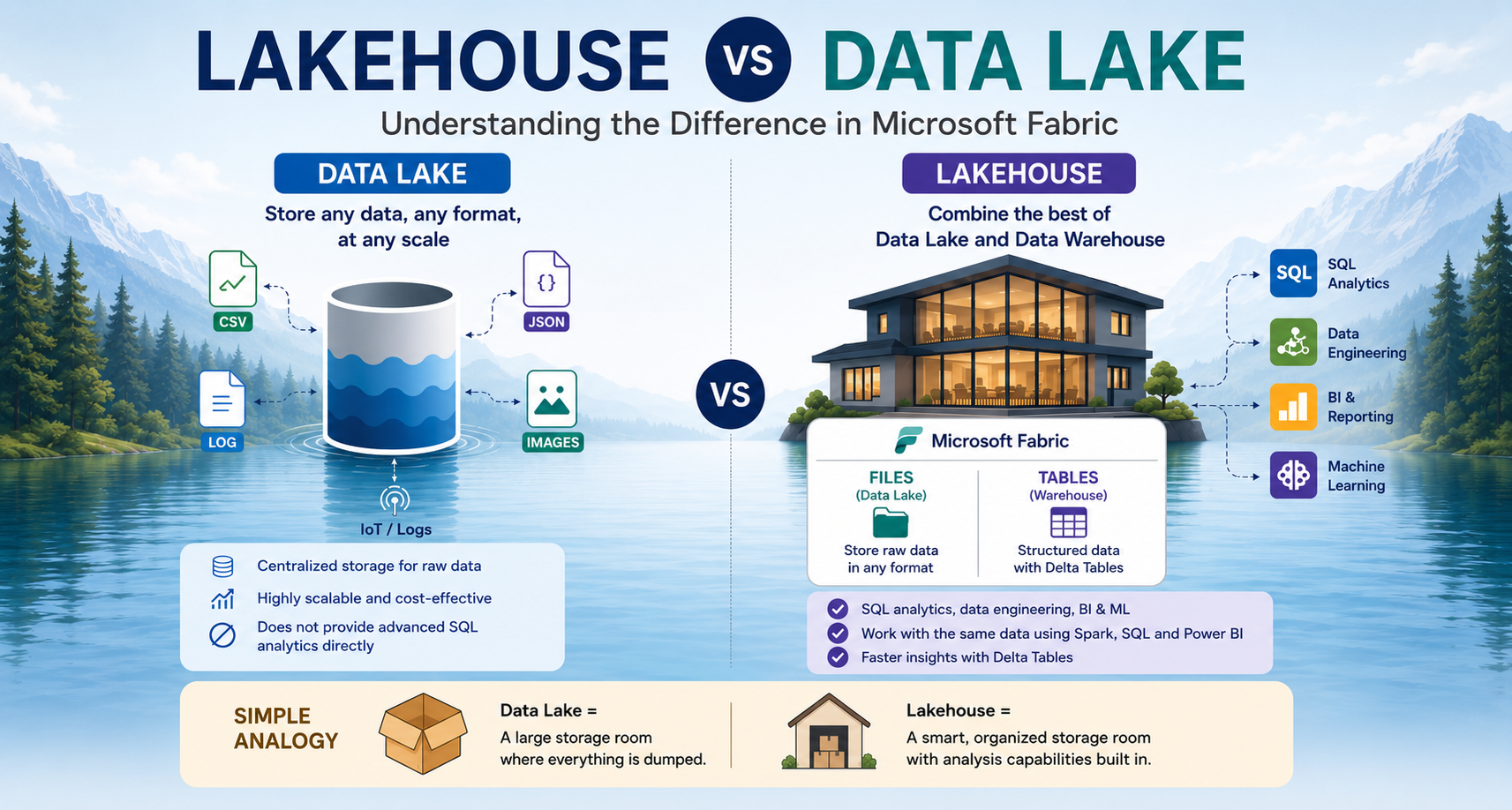
In today’s modern data world, terms like Data Lake and Lakehouse are becoming very common, especially while working with platforms like Microsoft Fabric, Databricks, and Azure. Many beginners often think both are the same because both deal with storing and managing huge amounts of data. However, there is a major difference in how they work and what they are designed for. Let’s understand this in a very simple way. What is a Data Lake? A Data Lake is a centralized storage system that stores large amounts of raw data in its original format. It can store: Structured Data → SQL tables Semi-Structured Data → JSON, XML Unstructured Data → Images, Videos, Logs The main purpose of a Data Lake is to provide scalable and low-cost storage. Example of a Data Lake Imagine a retail company collecting data from multiple sources: Customer purchase records Website clickstream logs Product images Social media data IoT sensor data from warehouses All this data can be stored directly into a Data Lake without much transformation. This makes Data Lakes very flexible. However, there is one challenge. A Data Lake mainly focuses on storage and does not directly provide optimized analytics capabilities like a traditional data warehouse. That means additional tools and processing are often needed before business users can analyze the data efficiently. What is a Lakehouse? A Lakehouse is a modern architecture that combines: The scalability of a Data Lake The analytics power of a Data Warehouse In simple words: Lakehouse = Data Lake + Data Warehouse Features A Lakehouse allows organizations to: Store raw data Perform SQL analytics Build Power BI reports Run machine learning workloads Process big data using Spark All using the same platform and same data. Example of a Lakehouse Let’s take the same retail company example. Instead of storing data separately in multiple systems: One system for storage Another for analytics Another for reporting The company uses a Lakehouse. Now: Raw files are stored in the Files section Cleaned and transformed data is stored as Delta Tables Analysts use SQL queries Data Engineers use Spark Business teams create Power BI dashboards All teams work on the same data without duplication. This improves: Performance Collaboration Data consistency Cost optimization Understanding with a Simple Analogy Data Lake Imagine a huge storage warehouse where everything is dumped: Boxes Files Documents Images Equipment The data exists, but finding and analyzing it efficiently requires additional effort. Lakehouse Now imagine the same warehouse but: Properly organized Indexed Categorized Ready for analysis You can directly search, analyze, and generate insights. That is what a Lakehouse provides. Lakehouse in Microsoft Fabric In Microsoft Fabric, a Lakehouse provides two important sections: 1. Files Section Used for storing raw data files. Examples: CSV JSON Parquet Images Logs 2. Tables Section Used for storing structured Delta Tables optimized for analytics. These tables can be accessed using: Spark SQL Endpoint Power BI This creates a unified analytics experience. Key Difference Between Data Lake and Lakehouse FeatureData LakeLakehouseMain PurposeStorageStorage + AnalyticsData TypeAll typesAll typesSQL AnalyticsLimitedStrong SupportBI ReportingRequires extra setupBuilt-in supportPerformance OptimizationBasicAdvancedData GovernanceLimitedBetter governanceUse CaseRaw data storageEnd-to-end analytics Why Organizations are Moving Towards Lakehouse Modern organizations want: Faster analytics Reduced data duplication Unified architecture Better collaboration between teams Cost optimization A Lakehouse helps achieve all these goals using a single platform. This is one of the major reasons why platforms like Microsoft Fabric and Databricks are heavily focusing on the Lakehouse architecture. Final Thoughts A Data Lake is excellent for storing massive amounts of raw data. But a Lakehouse takes it a step further by combining storage with analytics capabilities. In today’s modern data ecosystem, Lakehouse architecture is becoming the preferred choice because it simplifies data management while supporting analytics, reporting, and machine learning together. Understanding this concept is very important for anyone working in: Data Engineering Data Analytics Cloud Platforms Microsoft Fabric Big Data Technologies
No comments yet.