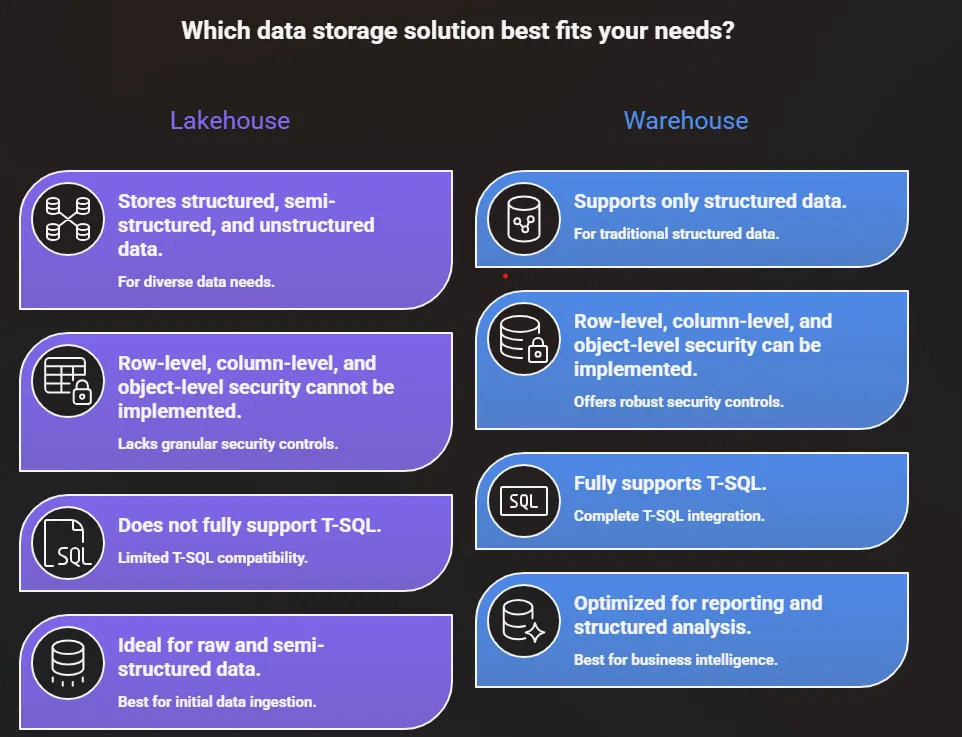
Lakehouse vs Warehouse (Microsoft Fabric) 🔍 Problem Choosing between Lakehouse and Warehouse is confusing because both store data but are designed for different workloads. 🧠 What the Image Clearly States (Exact Points Extracted) 🟡 Lakehouse Supports all types of data → Structured, Semi-Structured, Unstructured Does NOT support complete T-SQL Uses SQL Analytics Endpoint Less security RLS / OLS / CLS not present Performance is slower compared to Warehouse 🟡 Warehouse Supports only structured data Complete T-SQL supported Uses SQL Query Editor Better security Supports RLS / OLS / CLS Faster performance with SQL queries ⚙️ Detailed Explanation (Concept + Reasoning) 1. Data Type Handling Lakehouse → Built on Data Lake (Delta format), so it can store: JSON, CSV, Parquet, Images, Logs Warehouse → Strict schema (tables only) 👉 Reason: Lakehouse = flexible storage Warehouse = structured analytics engine 2. SQL Capability Lakehouse → Limited SQL via endpoint Warehouse → Full T-SQL (joins, procedures, views) 👉 Reason: Warehouse is optimized for BI workloads Lakehouse is optimized for data engineering 3. Security Lakehouse → Basic access control Warehouse → Advanced: RLS (Row-Level Security) OLS (Object-Level Security) CLS (Column-Level Security) Become a Medium member 👉 Reason: Warehouse is designed for enterprise reporting 4. Performance Lakehouse → Slower for SQL queries Warehouse → Faster for analytics queries 👉 Reason: Warehouse uses optimized compute engine for SQL execution 📊 Practical Example (Very Important) 🧪 Scenario: E-commerce Company Step 1: Raw Data Ingestion → Lakehouse Data sources: Website logs (JSON) Orders (CSV) Customer clicks (semi-structured) 👉 Store in Lakehouse 👉 Perform: Data cleaning Transformation (PySpark / Notebooks) Step 2: Structured Reporting → Warehouse Create clean tables: Sales Customers Products 👉 Load into Warehouse 👉 Use: SQL queries Power BI dashboards 🔄 How Both Work Together Lakehouse → Raw + processed data Transform → Clean structured data Load → Warehouse Analyze → Power BI / SQL 👉 This is called Medallion Architecture (Bronze → Silver → Gold) 🎯 Key Takeaway Use Lakehouse → Data Engineering + Raw Data Use Warehouse → Reporting + BI + SQL Analytics Best practice = Use BOTH together
No comments yet.