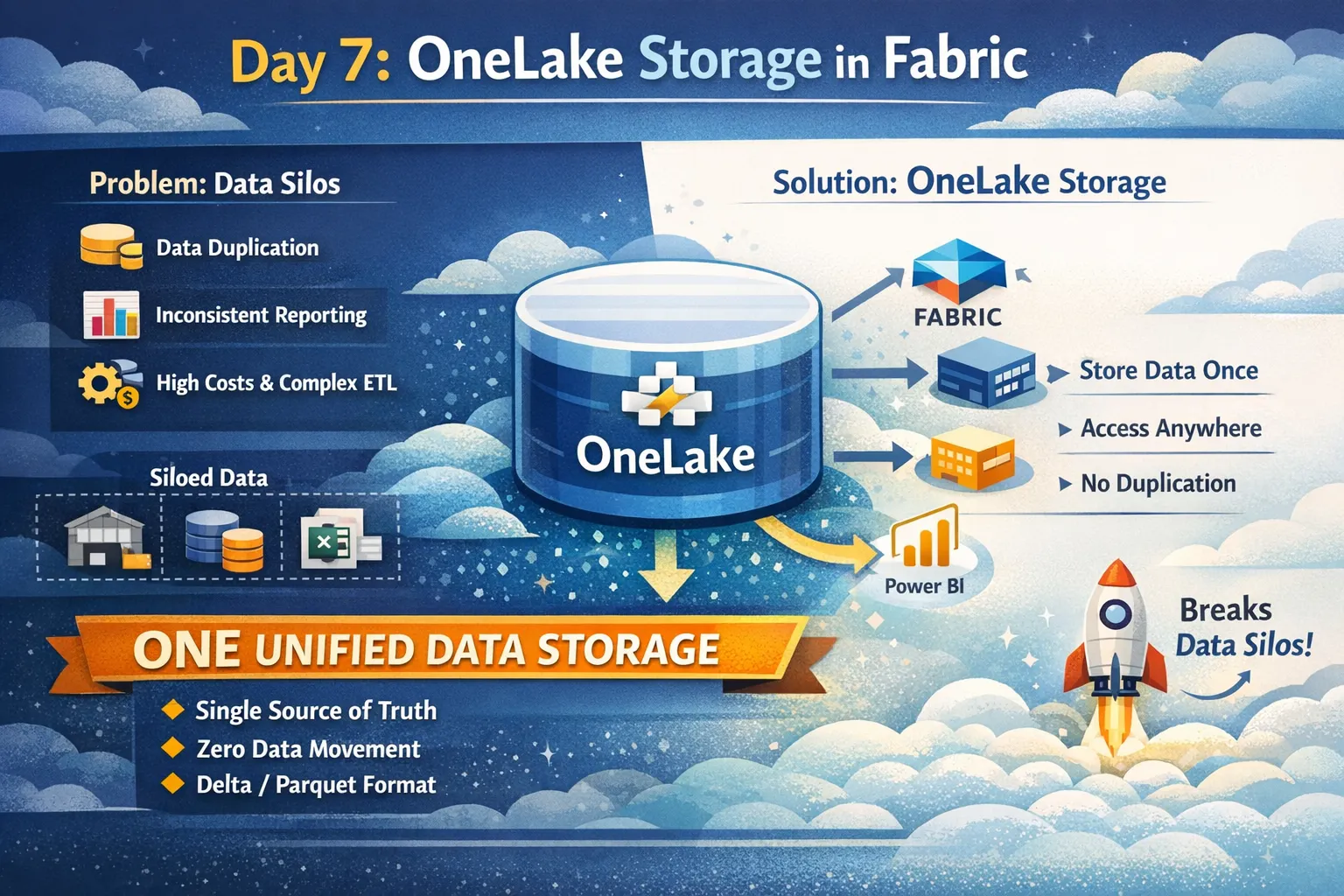
What is OneLake? 🔴 Problem: Data Silos in Modern Organizations In most enterprises, data is scattered across multiple systems — data warehouses, data lakes, SaaS apps, Excel files, etc. This creates: Data duplication → Same dataset stored multiple times Inconsistent reporting → Different teams see different numbers High storage cost → Redundant copies Complex pipelines → ETL just to move data between systems 🟢 Solution: OneLake in Microsoft Fabric OneLake is a single, unified data lake built into Microsoft Fabric. Think of it as the “OneDrive for Data” across your entire organization. ⚙️ How OneLake Works (Conceptual Flow) Data is stored once in OneLake Fabric services access it directly (no movement required) Uses Delta/Parquet format for optimized performance Supports shortcuts → access external data without copying 📌 Example (Real-world Understanding) Suppose your company has: Sales data (used by BI team) Customer data (used by analytics team) Finance data (used by reporting team) Write on Medium ❌ Traditional Approach: Same data copied into: Data Warehouse Data Lake BI models Result → multiple copies of same data ✅ With OneLake: Store data once in OneLake Access via: Lakehouse (Data Engineering) Warehouse (SQL Analytics) Power BI (Reporting) 👉 No duplication, no movement 🧠 Key Features of OneLake Single Source of Truth → Everyone queries same data No Data Movement → Zero-copy architecture Open Format → Delta/Parquet (no vendor lock-in) Shortcuts Feature → Connect external sources like ADLS, S3 Automatic Availability → Every Fabric workspace gets OneLake 🎯 Why It Matters (Interview Insight) Eliminates ETL pipelines just for duplication Improves data governance & consistency Reduces latency + cost Enables real-time collaboration across teams 🔑 Key Takeaway OneLake = One unified storage layer for the entire organization ➡️ Store once, use everywhere ➡️ Breaks data silos completely
No comments yet.